Pmh of Baby Note Pmh of Infant Progress Note
Well-Child Care: Promoting Health and Evolution
A Chapter in Core Concepts of Pediatrics, 2nd Edition
Well-Child Care: Promoting Health and Evolution
Bister Hairfield Exercise and David P. McCormick Md
Pediatricians are in a unique position to contribute to the good health and success of children under their care. A pediatrician often has the opportunity to know the family from the birth of the kid and understands the social, medical and developmental factors that tin potentially interfere with normal office. The pediatrician can facilitate medical management, provide a referral to a specialist when necessary, work closely with schools and agencies to provide necessary additional services, and initiate community action projects to accost important health issues.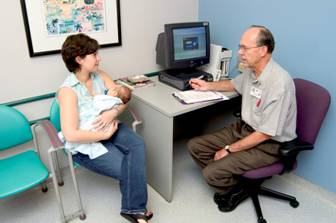
It has been said that "the child is not merely a small adult." Children differ from grown-ups in both physiology and pathology. They also differ from each other. The health needs of infants, children, and teenagers are not identical.
This affiliate will aid you learn to:
- obtain a history and perform a physical examination in infants, pre-schoolhouse, and school-age children,
- provide age-appropriate health-maintenance advice,
- appraise and recognize mutual variations in development, and
- employ growth charts to recognize mutual variations in growth.
Prior to entering the examination room
Familiarize yourself with the electronic medical tape (EMR). Look at the Chart Review tab to scan the patient encounters. Be sure to familiarize yourself with the Past Medical History, Social History, Growth Nautical chart, and Medications tabs. Students may update the information in the social history. Students may write a progress annotation and may enter and 'pend' orders.
Use of Worksheets
During a properly conducted well-child visit, a wide range of medical and social bug demand to be addressed. A sample worksheet has been provided to obtain the kid and family medical and social history at the first visit for a child of whatever age. On the left sidebar, at that place are worksheets specific for each age grouping.
These worksheets assistance to ensure that you lot remember to address issues in the history, concrete examination, and social development that are specific to the historic period grouping.
Check off organ systems as yous examine them and document any abnormal findings. Make a annotation of whatsoever of those systems you are unable to examine, eastward.g. ear canals that were occluded with wax, or if child was crying so loudly that you lot could not hear the heart sounds. Use the worksheet to nowadays your findings to your preceptor.
Links on each worksheet volition take you to additional information. Nosotros recommend that y'all spend some time exploring each checklist earlier you examine your offset patient.
Note: For patient confidentiality, be sure y'all shred any temporary documents after yous no longer need them.
Clothes and Demeanor in the Examining Room
Remember that parents appreciate a professional demeanor. If y'all habiliment a white jacket, it should exist clean. Dress accordingly. No open-toed shoes. No blueish jeans. No chewing gum. Exist sure your proper name tag is easily visible, worn on your upper torso near your face, with the photograph showing. Generally, men should wear a tie and women should exist sure that their attire is modest.
Meeting a Family for the Kickoff Time
When yous are meeting a new family unit, always innovate yourself properly and analyze your part in the clinic. For example: "I am Julie Smith, a medical student working in the pediatric clinic this month."
| More Information |
| Cultural Differences: Exist sensitive to the fact that life-styles, dietary habits, and the approach to illness may exist different in families of unlike ethnicity and cultural backgrounds. Do non presume that your outlook is necessarily shared by the child's family. If y'all have a question most a cultural practise with which you lot are unfamiliar and it relates to the medical care of the patient, please respectfully ask about the cultural exercise from a perspective of curiosity, taking care non to come across equally judgmental. This helps to better sympathize family practices and build rapport. If y'all don't enquire, y'all might miss some of import medical information. Alternative or Complementary Medicine : Such therapies are almost probable to be used for chronic illness. Enquire about this with sensitivity; families will not oftentimes volunteer this information. After you accept the history of previous medical therapy, a general question such every bit, "Is there anything else that you lot take tried for this condition?" may be helpful in eliciting these details. |
Respect the parent's status by using proper titles, "Mr. Smith", "Mrs. Jones", "Dr. Doe". Place language barriers and utilise a certified translator when needed. The need for a translator can exist anticipated by looking on the tiptop dashboard for "preferred linguistic communication" and "translator needed: yes/no." The child's siblings should non translate.
As a beginning student, if time and the parent permits, it is a good idea to do taking a complete history on every patient, even if the patient is non new to the practise. This volition assist you lot learn.
Preparing for a physical examination
Remember to wash your hands or use hand sanitizer in the examining room before and afterward examining each patient. Excuse yourself and whatever siblings, if necessary, while the child dons a gown. Infants do not require draping for modesty, but may need partial covering to be kept warm and comfortable.
Schoolhouse historic period children like to be draped properly during the examination using a gown and canvas/blanket when needed. Be sure y'all use proper gowning and draping procedures for all children, regardless of age. Shirts and pants should be removed, in social club to examine all skin surfaces and so as not to examine to the heart and lungs through wearable, which is not skillful technique. Leave on the underpants, for modesty, until getting to the genital exam. Proper gowning and draping provide comfort for all. Be sure the child has sufficient privacy when undressing.
Apply a calm vocalism and talk to the parent and child throughout the exam every bit you perform each step, so there is understanding of what you are doing.
Obtaining the Initial History at the Showtime Visit
A worksheet follows which will permit you to obtain the kid and family'south medical and social history at the first visit for a child of any age. A print version is available on the sidebar.
Child and Family Medical History
| Current Health Status | |
| Gestation History | |
| 1. Gravida:_____Para:_____Abortions:_____ | 8. Maternal medications / drugs used during pregnancy 9. Maternal bug during pregnancy: __anemia __hospitalization __syphilis __cardiac disease __hypertension __U.T.I. __diabetes __Rh negative __vaginal bleeding __gonorrhea __rubella __hepatitis __herpes __seizures |
Birth & Nursery Course
12. Place of Nativity:_____________________________________________
13. Problems during labor and delivery? (eg. Induction, postpartum hemorrhage)_______
______________________________________________________________________
14. Type of delivery: spontaneous, forceps C-Department. Length of labor:_____ hours
xv. Baby's condition at nascency: _______________APGAR: 1 min:_____5 min:_______
16. High risk nursery? Yeah No Length of time:______
17. Nativity weight: Length Head Circumference: Small/big for gest age
18. Problems:
__birth defects __convulsions __meningitis/sepsis
__blood transfusions __feeding problems __oxygen or respirator used
__congenital infections __jaundice __other
| Family Medical History | ||
| ___allergies | ___hypertension | ___alcoholism, drug addition |
| ___kidney disease | ___hematologic | ___mental illness |
| ___cancers | ___neuromuscular | ___incarceration |
| ___overweight | ___epilepsy | ___diabetes |
| ___hearing problems | ___tuberculosis | ___stroke |
| ___other disorders | ____drug/alcohol corruption | ___heart diseases |
| Medications taken regularly |
Diet History
Nutrition: see age specific worksheet
Quickchecks on the Initial History and Showtime Visit
Health Assessments of the Infant (0 through 11 Months)
In the first year of life, routine visits are scheduled during the first and second weeks of life, and at two, 4, 6, 9 & 12 months.
The infant'southward first visit to the office may be as early on as 2-iii days of historic period. Good for you babies are discharged from the nursery afterward 24 to 48 hours. This is a critical time for establishment of breastfeeding and assessment of problems such every bit jaundice. If the child is only a few days old, review the physical examination of the newborn and familiarize yourself with some of the common neonatal medical issues before you brainstorm the baby health maintenance test.
| More than Information |
| Complete family medical and social history: Information virtually the family history tin best exist obtained by kickoff with open-ended questions such as, "Tell me most whatsoever medical problems your family members may have had?" You lot should inquire about the firsthand family and grandparents. Extend the pedigree if the family has a history of hereditary diseases, or if other family members play an important part in the kid's life. Immunization Tape: The basic serial of immunizations recommended by United States public wellness experts tin be found here, but many clinics vary the recommended schedule, depending on their sources of funding, whether they take access to new multiple antigen vaccines, and if they are experiencing shortages. Ask your preceptor for a re-create of the currently recommended schedule at your clinic site. |
The first visit to the function volition require a complete family medical and social history, including family history of illnesses, pregnancy history, and birth history.
Print a current re-create of the immunization schedule so you can consult it and learn which immunizations are given when. Recommendations for immunizations change often, so maintain your updates frequently.
Review the Infant Cess worksheet. We recommend that you spend some fourth dimension exploring the "Birth to xi Month Worksheet" and the related data before you examine your first patient.
Health Assessments of the Infant (0 through 11 Months)
The Birth to xi Month Worksheet
Infant health maintenance worksheet (nativity to 11 months) is available on the sidebar. Click on the highlights beneath for more than detail or to branch to a hyperlink within the popup. You tin can go to a print version of the form on the side bar.
Common Variations in Growth Patterns of Infants
Quickchecks
Health Assessment of the Preschool Child (12 months - through 4 years)
Health maintenance visits are scheduled at 12, 15, and 18 months, 2 years, and yearly thereafter.
The preschool child speedily develops complex social and neurobehavioral capabilities, and the parents often have questions near the child's beliefs and social functioning. Knowledge and experience are needed to differentiate normal variations from aberrant beliefs. Utilize this opportunity to observe normal and abnormal growth and evolution in preschool children, and detect how experienced pediatricians approach these problems.
If a complete family medical and social history has not previously been obtained, do so now along with the toddler/preschool historic period health cess.
Start at around 2 years, it is possible for the clinician to have a conversation with the child. Simply don't try to obtain any useful medical data. The answers you go are likely to exist random and make-believe. That doesn't mean you should not communicate- it is a lot of fun and helps to put the child at ease.
By three years of age, children ask lots of questions about the doctor'south office and what you are doing. By explaining to the child, you tin model skillful communication skills for the parent and also observe how the parent reacts to the kid's behavior. Tell the child what yous are going to do. Doc: "Now I'1000 going to cheque your lungs". Kid: "What's lungs?" Doctor: "Lungs help you lot become air". Child: "What's air?" This chat can continue every bit long as you like.
A good way to relax the child is to allow him or her to sit on the parent's lap during the exam. Cartoon a piffling smiley face on the end of a tongue bract and playing a game of hide and seek with the face can assistance distract a nervous kid.
Almost all the of import organ systems tin be examined with the child on the parent's lap. Using your own exam equipment tin foreclose the need to place the child on the examination table or pulling the cord of the otoscope beyond the room to where the parent is sitting. A fearful child on the exam tabular array may have two people to concur, but with the child in the lap, the parent can cuddle the child'southward hands while you examine "difficult" areas such as the throat and ears. Keep talking to relax the child. Don't speak too loudly. Employ a comfortable tone of voice. Children are little, merely not hard of hearing. Loud voices commonly plow them off. Children also like eye contact.
Health assessment of the Preschool Kid Worksheet (12 months - 4 years)
The 12 Month to iv Years Worksheet
The preschool child health maintenance worksheet, (12 months to 4 years) is available on the sidebar. Click on the highlights beneath for more detail or to branch to a hyperlink within the popup. You can get to a print version of the form on the side bar.
Health Cess of the Schoolhouse-Age Child (5-12 Years)
The Worksheet
All children should have a yearly health maintenance visit. By six years of age, most children can provide reasonably authentic medical information, and information technology is a skillful idea to talk to the child as well as to the parent.
If this is patient is new to yous, obtain the consummate family medical and social history. Apply the School-Age Child Health Maintenance guide to complete the historic period-related history and physical examination.
Click on the highlights beneath for more than particular or to branch to a hyperlink inside the popup. You tin become to a impress version of the form on the side bar.
Quickchecks: Developmental Milestones
Astute Care Visit
On average, about half of the visits to a pediatrician's office will be for astute care. Such a visit, differs from a well-kid or follow-upward visit.
| More Information: Documenting the visit |
| The physician documents the well child visit differently from the acute care visit. Payment is based on the documentation. The amount of documentation depends upon the complexity of the case and the extent of the physical examination necessary to make a diagnosis. A carefully constructed set of guidelines used by all doctors in the Usa describes the documentation that is needed for billing acute care visits of differing complexity. As a pupil, you do not demand to know this now, merely every bit a resident, you will have to document at the advisable level for outpatient visits. For instance, documenting the unproblematic ill visit (established patient) requires two of the post-obit three key component:
|
The typical acute care visit for the sick child just requires a pertinent past and present history, and examination only of the problem-specific organ organisation(s). In this state of affairs, your preceptor may ask yous to take only a brief history and examine simply the involved system. Be sure to ask your preceptor if yous aren't sure how much history to have and how comprehensive the examination should be.
Resource and References
Acute Otitis Media, David McCormick (Ed)
Immunization Record, CDC
Seats and Seat Belt Protection, American Academy of Pediatrics
Source: https://www.utmb.edu/pedi_ed/CoreV2/WellChild/WellChild_print.html

Post a Comment for "Pmh of Baby Note Pmh of Infant Progress Note"